IG KANJA REAFFIRMS NPS COMMITMENT TO PROFESSIONAL, PEOPLE-CENTRED POLICING AT NCAJ COUNCIL MEETING
The Inspector General of Police has reaffirmed the National Police Service's commitment to delivering professional, accountable and people-centred policing through continuous institutional reforms, adoption of technology, strengthened investigations and enhanced inter-agency collaboration.
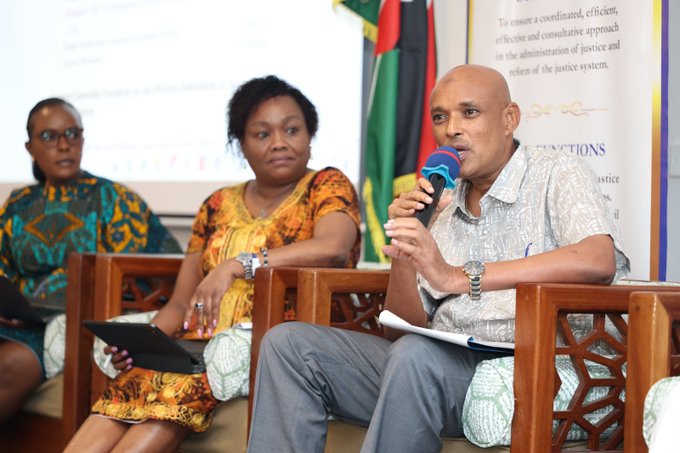
The Inspector General's message was delivered by the Director of Criminal Investigations, Mr. Mohamed I. Amin, during the 38th National Council on the Administration of Justice (NCAJ) Council Meeting, chaired by Chief Justice Martha Koome.
The meeting brought together key justice sector stakeholders to deliberate on strategic reforms aimed at strengthening the administration of justice and enhancing service delivery. In her remarks, Chief Justice Koome underscored the importance of collaboration among justice sector institutions, stating that, "Collaboration strengthens, rather than diminishes, institutional independence." She further observed that the success of justice sector reforms will be measured not by the number of policies approved or meetings convened, but by the tangible improvements experienced by Kenyans who rely on the justice system.
In his address, the Director DCI noted that the Standard Operating Procedures (SOPs) for the Effective Management of Sexual and Gender-Based Violence (SGBV) and the operationalization of the Instant Traffic Fines Framework underscore the need for stronger institutional collaboration to enhance access to justice, improve service delivery and strengthen public confidence in justice sector institutions.
On the fight against SGBV, the Inspector General reaffirmed the National Police Service's commitment to a survivor-centred, evidence-led and technology-enabled response. He highlighted key interventions, including strengthening specialized SGBV investigations through the Anti-Human Trafficking and Child Protection Unit; expanding survivor support services through POLICARE Centres; enhancing accessible reporting channels, including #FichuaKwaDCI, toll-free lines and community policing structures; leveraging technology through the Forensic Exhibit Management System; strengthening collaboration with local, regional and international partners; and intensifying public awareness campaigns to prevent SGBV.
The Inspector General also called for continued inter-agency alignment on the Draft Sexual Offences (Amendment) Bill, 2025, and the SGBV SOPs to ensure their consistent application from the police station to the courtroom.
On the operationalization of the Instant Traffic Fines Framework, the Inspector General noted that the system, implemented jointly by the National Transport and Safety Authority (NTSA), the National Police Service (NPS), the Office of the Director of Public Prosecutions (ODPP) and the Judiciary under Sections 117 and 117A of the Traffic Act (Cap. 403), remains fully operational nationwide. He added that the National Police Service continues to support enforcement, safeguard evidence integrity and facilitate the referral of contested cases to court in close collaboration with NTSA and the Judiciary.
He further called on the Council to support continued inter-agency harmonization of the Instant Traffic Fines Framework with due process safeguards to strengthen the programme against legal challenges while enhancing access to justice for the benefit of all Kenyans.